Choose your language
 English


Choose your currency
€ - eur
English
Your cart is empty.
Geplaatst op 30-08-2024 door Frank Andringa
Condensation or moisture inside your watch should never be ignored. A light haze under the crystal can sometimes appear after a sudden temperature change, but recurring condensation or visible water droplets may mean that moisture has entered the watch case. Acting quickly can help prevent corrosion and damage to the dial, movement and other components.

Condensation underneath the crystal can indicate that moisture has entered the watch case.
Condensation on the inside of the watch glass becomes visible when water vapour inside the case condenses against the colder crystal. This can happen after moving quickly from a cold environment into a warmer one.
A very light haze that disappears quickly is generally less urgent than actual drops of water. Recurring condensation still deserves attention. A properly sealed watch is designed to keep external moisture out, so repeated fogging may indicate a problem with a gasket, crown, crystal or case back.
Want to understand the water resistance rating printed on the back of your watch? Read our complete guide: how water-resistant is your watch?
Moisture in your watch: what should you do right now?
Water can enter a watch through several vulnerable points. Common causes include an incorrectly closed crown, worn or damaged seals, a damaged crystal, a case back that no longer seals correctly or exposure to greater water pressure than the watch was designed to withstand.
Typical causes of moisture inside a watch:
Unsure whether your watch was designed for swimming or other contact with water? Our guide explains what 10 ATM means and how watch water resistance works , including the differences between 3 ATM, 5 ATM, 10 ATM and 20 ATM.
Water resistance can deteriorate over time. Seals are wear parts, so a watch that was water resistant when new is not automatically guaranteed to retain exactly the same resistance many years later.
If your watch has other symptoms as well, see our guide to 10 common watch defects.
Not every sign of moisture carries the same level of urgency. What you see under the crystal can help determine the appropriate next step.
Very light temporary haze
Possible meaning: this may occur after a rapid temperature change.
Recommended action: monitor the watch carefully and keep it dry.
Condensation that keeps returning
Possible meaning: the watch may have a problem with a gasket or another sealing point.
Recommended action: have the water resistance and seals professionally checked.
Visible water droplets
Possible meaning: water has entered the watch case.
Recommended action: arrange a professional inspection as quickly as possible.
First, remove the watch from any wet environment and carefully dry the exterior using a soft cloth. Keep the watch in a dry place at normal room temperature.
Do not operate the crown or chronograph pushers while the watch itself is wet. Manipulating these controls may compromise the seal and can make it easier for additional moisture to enter.
Once the exterior is completely dry, leave further opening or disassembly to a watchmaker unless the manufacturer specifically states otherwise.
If the condensation disappears completely and does not return, continue to monitor the watch. If it comes back, have the seals and water resistance checked before exposing the watch to water again.
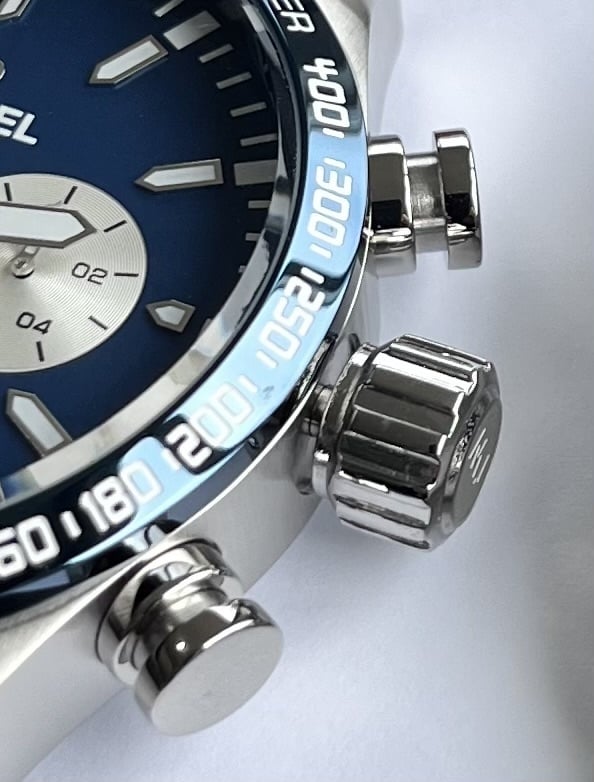
The crown is one of the points through which water can enter a watch if it is not properly sealed.
Trying to accelerate the drying process can sometimes make the problem worse. The goal is not only to remove visible condensation, but also to find and repair the point where moisture entered.
Avoid these common DIY solutions:
Drying the visible condensation is not the same as restoring the watch's water resistance. If moisture entered through a worn gasket, damaged crown or another sealing problem, that underlying cause still needs to be corrected.
How you can use a water resistant watch depends on its construction, condition and the manufacturer's specifications. A rating alone does not tell the complete story.
3 ATM / 3 bar / 30 m
General indication: everyday splash resistance.
WatchXL advice: suitable for rain and accidental splashes, but not intended for swimming.
5 ATM / 5 bar / 50 m
General indication: enhanced everyday water resistance.
WatchXL advice: check the manufacturer's instructions before swimming and avoid hot water and steam.
10 ATM / 10 bar / 100 m
General indication: higher water resistance.
WatchXL advice: often suitable for swimming and water sports, but not automatically suitable for scuba diving.
20 ATM / 20 bar / 200 m
General indication: very high water resistance.
WatchXL advice: suitable for demanding water use depending on the model. Check whether the watch is actually certified for diving.
DIVER'S 200 m / ISO diver
General indication: designed and tested as a diving watch.
WatchXL advice: choose a genuine dive watch when you need a watch for scuba diving.
These ratings are a general guide. Always follow the specifications and operating instructions supplied by the manufacturer of your particular watch.
For a more detailed explanation, see our guide to watch water resistance.
Looking for a watch made for use in the water?
A genuine dive watch is designed for more demanding conditions than an ordinary splash resistant watch. Explore models from brands including Citizen, Luminox, Timex and Bulova.
Citizen fans can also browse the Citizen Promaster Marine collection, which includes watches specifically developed for use on and under the water.
Want to know what distinguishes a true diving watch from an ordinary water resistant watch? Read our guide to ISO 6425 diving watches.
If you can see actual droplets of water inside the watch, professional inspection should not be postponed. The same applies when condensation remains visible or repeatedly returns.
A watchmaker can open the case in a controlled environment, remove moisture, inspect the movement for corrosion, check or replace the seals and perform a pressure test afterwards.
A pressure test is important because simply making the glass clear again does not prove that the watch is water resistant.
Extra tip: if your watch is regularly used for swimming, sailing or diving, include a water resistance check as part of its maintenance. You can find more maintenance advice in our guide to keeping your watch in top condition.
Whether water damage is covered depends on the cause of the problem and the warranty conditions of the brand. Damage caused by an incorrectly closed crown, unsuitable use in water or use beyond the watch's specifications may fall outside warranty coverage.
If you bought your watch from WatchXL and believe there may be a manufacturing defect, do not open the watch yourself. First read our warranty and complaints information or contact WatchXL.
Very light condensation can sometimes disappear when the watch returns to a stable temperature. However, condensation that remains or repeatedly returns suggests that moisture is present inside the case and should be investigated.
Rice is not a reliable repair for a watch with water inside it. Even if the visible condensation disappears, the seals may still be defective and moisture may remain around the movement. Professional inspection is the safer solution.
No. Concentrated heat can affect seals and delicate watch components. Keep the watch dry at normal room temperature and have persistent moisture professionally checked.
A 10 ATM or 10 bar watch is commonly designed for swimming and more substantial contact with water, but you should always check the specifications of the specific model. A 10 ATM rating alone does not make a watch suitable for scuba diving.
Repeated fogging can indicate that moisture is already inside the case or that a crown, gasket, crystal or case back is no longer sealing correctly. Have the watch pressure tested before exposing it to water again.
A brief haze after a temperature change does not always mean serious damage, but recurring condensation or visible water droplets should never be ignored. Keep the watch dry, avoid heat and do not operate the crown or pushers while the watch is wet. If moisture remains or returns, a professional inspection and water resistance test can help prevent further damage.